
National Mall, Washington D.C. 
“nihilistic slab of stone” (1)
“black gash of shame” . . . “a degrading ditch” (2)
“a black trench that scars the Mall. Black walls, the universal color of shame and sorrow and degradation. Hidden in a hole in the ground, with no means of access for those Vietnam veterans who are condemned to spend the rest of their days in a wheelchair. Perhaps that’s an appropriate design for those who would spit on us still. But can America truly mean that we should feel honored by that black pit?” (3)
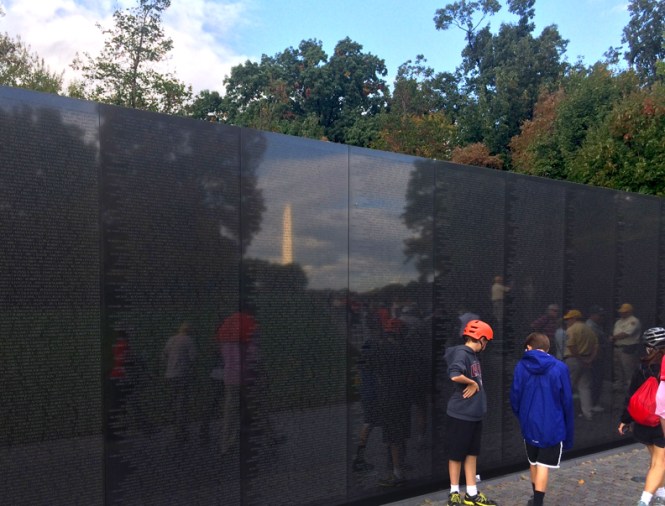
The quotes above are just a few of the many criticisms lobbied against the winning design by Maya Lin and today seem overly harsh for such an admired memorial dedicated to the lives lost during the Vietnam War. At the time during the early 80’s, given that the war was a recent event, the general public and the media was outspoken in their attacks against the memorial and the perceived statement they felt it was trying to make. Much of this reactive critique was subjective judgements made in passing, coming from their own interpretations of the war as if the memorial was placing itself on some oppositional ground in relation to their own. To many this design was a betrayal to the very idea of what a memorial should be. The uncommon use of polished black granite instead of using white limestone or marble (4) and the horizontal nature of the design which situated itself in contrast to the great vertical monuments of the past was a distinct break from convention. For a memorial that seemed to lack political statement it certainly triggered a heated debate. Looking back much of it was due to the polarity in people’s feelings about the war and also in the confusion of the project’s aims. The people and critics expected to see a monument as a tribute to an important event and failed to see a memorial as a remembrance for those who died.

When the project founder, Vietnam War veteran Jan Scuggs, proposed the memorial for the competition he felt that the submitted designs should avoid making statements about the correctness of the war. “Rather, by honoring those who sacrificed, we hope to provide a symbol of national unity and reconciliation.” (5) When researching designs, Lin felt she had the opportunity to design a memorial that would honor those lives lost and to steer away from past memorials which aim at more general statements about the war’s achievements. (6) Lin’s winning design is very much in line with Scuggs statements in the program, “the memorial should be conciliatory, transcending the tragedy of the war.” (7) After reviewing 1,421 submissions for the memorial, the competition committee selected Lin’s design but this decision was soon met with a backlash even coming from initial supporters of the fund. Maybe Scuggs underestimated the public reaction and was too idealistic in thinking that people would set aside their opinions for a memorial that he hoped would transcend any statement. The war was certainly controversial and you can’t blame people for the strong reactions which would bring the project to a temporary halt. The critics felt the memorial was a severe break from tradition and eventually a compromise was made with the addition of the Three Soldiers Statue nearby the memorial. The need for some semblance to convention is a typical response and when faced with changing circumstances the immediate reaction for most people is that they rather it not happen during their time and not in their place.
My first proper introduction to the memorial was during my first year of architecture school which was over fifteen years past the memorial’s date of completion. Here I encountered universal praise for the design in stark contrast to the aforementioned negative statements. Lin’s project was covered in class lectures and I further read about it in library books; the memorial was unanimously toted as an important work of landscape architecture and a groundbreaking achievement as a contemporary monument. The design became an inspiration on a number of my own projects, most notably in a project proposal that involved placing a factory within a historic aqueduct park setting. The influence of the design was evident in how the obtrusive nature of the factory was set within the historic landscape by suppressing the more severe parts of the factory into the slope of the ground. The emerging features such as the overhead assembly lines for the factory were placed in a respectful manner in relation to the towering ruins of the Roman aqueducts. Here I was using the relationship of site and form as seen in Lin’s memorial as a conceptual tool. If asked, I felt I understood the memorial very well, yet in fact much of my understanding was only from a design standpoint and for a project I admired immensely I had yet to visit the site in person. Though I was never critical of the memorial, my knowledge of it came from just as a detached perspective than the earlier critics. We were only seeing it through our own desires and aims.

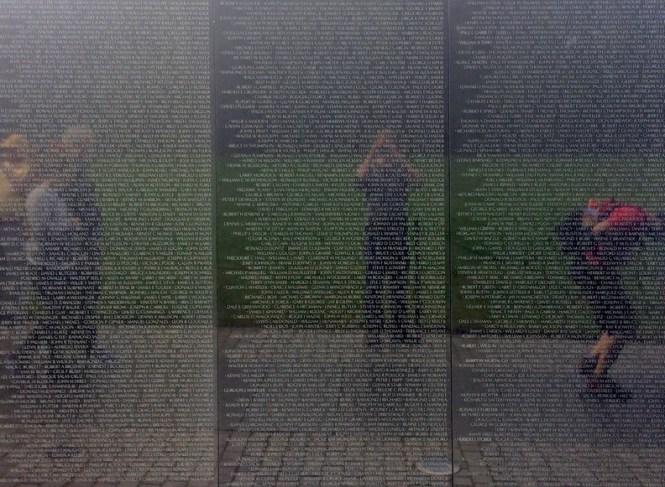
In 2014, when I visit the site in person, the striking reality is that I’m experiencing the memorial for the first time and no longer as a detached concept of drawings, pictures and text serving as a design influence. As I move into the site I am struck by the reflective quality of the dark granite which doubles myself and the bodies of others. Myself and its other situated outside and within the softened surface of the wall as I experience a very intimate scale and relationship with the site and most importantly with the names which imprint the walls reflective interface. Over 58,000 names are listed row upon row in chronological sequence along the length of the wall and all around eye level. Over to my side I see someone “rubbing” a name. This is the process of transferring the name with a pencil or crayon onto a piece of paper creating a physical form for one to carry home as a reminder of a loved one. I see someone reach out to touch a name and their double reciprocates the action from the other side as they come into direct contact with a name. I think of the captious quote which compared the use of the names as a mode of listing, “Not as a death of a cause but as they might as well have been traffic accidents.” (8) This is nothing of that sort with a very tangible and personable experience. Though the names lack a grandness in scale or height as seen by the inscription of the Gettysburg Address in the nearby Lincoln Memorial, the names take on a more intimate feel. I start to read names on the wall and even sound out some as I give voice to those who never got their say. One power the memorial has is that I can’t help to not tear up when I come face to face with all these names and I struggle to control the swell of emotion. It’s hard to comprehend the immensity of it all, not knowing the individual circumstances each person faced but here they are brought together in one solemn place. At the end of the day you can’t fault a person’s sentiments when a subject is so near and dear. You can only hope that with time the underlying meaning of things will emerge and withhold over time.
“Brought to a sharp awareness of such a loss, it is up to each individual to resolve or come to terms with this loss. For death is in the end a personal and private matter, and the area contained within this memorial is a quiet place meant for personal reflection and private reckoning. ” Maya Lin (9)
(1) Wills, Denise. “The Vietnam Memorial’s History.” Washingtonian.
(2) Marita Sturken, “The Aesthetics of Absence: Rebuilding Ground Zero,” American Ethnologist 31, no. 3 (August 2004): 122.
(3) Veteran Tom Carhart quoted in Elizabeth Hess, “Vietnam: Memorials of Misfortune”, in Unwinding the Vietnam War: From War into Peace ed. Reese Williams (Seattle 1987) 265.
(4) The Vietnam Veterans Memorial is a stark contrast with the whiteness and verticality of the Lincoln Memorial, Washington Monument and the World War II Memorial all nearby in the National Mall.
(5) Karal Ann Marling and Robert Silberman, “The Statue Near the Wall: The Vietnam Veterans Memorial and the Art of Remembering,” Smithsonian Studies in American Art 1, no. 1 (Spring 1987): 10.
(6) Maya Lin, Boundaries, Simon & Schuster Paperbacks, New York, 2000, pg. 4:09.
(7) Vietnam Veterans Memorial Competition Design Program, Washington D.C., 1980, 16.
(8) “Stop that Monument”, National Review, 18 Sep. 1981, 1064.
(9) Lin, pg. 4:05.
All photographs Tyska Sullivan ©2014
 Tyska Sullivan