Wear And Care

To protect a building or home from the outside elements it is vital that the material components of the exterior skin are durable and well-maintained. Every object is subject to the 2nd law of thermodynamics (1), the universal law of decay, and without any maintenance protocol, the effects of this perpetual disorder are costly. The deterioration is not consistent and exposure is an important determinant in the higher rates of failure at more susceptible areas. Precipitation is a fact of life and the external dynamics of wind, rain, and the lack of sunlight to dry out surfaces contribute in the freeze/thaw process; a dangerous cycle of exponential material decline.

In the construction industry, brick and mortar is the “tried and true” building material owing to its uniformity, reliability, ease of production and craft. (2) “High-technology” construction materials require specialized labor, while the brick with its corresponding scale related to the worker’s hand has been used throughout history, across many climates and cultures. Brick and mortar construction is a flexible system with the ability to add units, remove sections, cut into walls, and infill openings at any time. It also has the particular ability to be both structure and skin. As a structural support it can extend from foundation to the roof as it bears the horizontal members at each floor. As a skin it functions as a permeable barrier to protect against the external elements and to allow the wall to breathe, therefore allowing excessive moisture out. It is important to note that the exterior wall stands between the differing interior/exterior temperatures and humidities, which seek equilibrium.

BrickParapet-2014

Brick Parapet Section, Oil pastel on paper, 21-3/4 x 29-3/4″ © Tyska Sullivan

A breach at the building’s membrane will occur due to several factors such as the aging of materials, environmental conditions or just poor design/construction details. One of the merits of brick masonry is its ability to reveal the signs and symptoms which relate to a corresponding pathology. Efflorescence (3) at the wall’s exterior suggests excessive moisture built-up at the wall’s interior and its persistent migration to the surface. Water is likely infiltrating at a source nearby or above the problem condition. (The source of water could be from below if the efflorescence is near the foundation) This revealing process is beneficial in diagnosis and treatment, whereas with some modern material and cladding, the signs and symptoms are not as readily apparent and the exterior will maintain its typical look while concealing the underlying issues.

In a lot of cases the sign of the pathological condition exists but is not corrected in time. Deferred treatment  for a condition can only lead to accelerated deterioration later on. For example in Parapet Rebuild (title image), there were open joints at the coping stones which cap the top of the parapet. This breach in the building’s exterior membrane led to water build-up at the interior cavities of the wall. Moisture is at its worst when it’s in a position to freeze, leading to the expansion of water at the time of freezing. The expansion will put pressure at the surrounding masonry, (4) in this case showing up as a vertical cracks at the exterior of the wall and extending the height of the parapet. The new cracks allow an added source of water infiltration, which means more expansion and pressure upon the materials, continuing a very dangerous cycle. At this point it’s too late to seal the original source of water infiltration at the open joint of the coping stone because the wall cracks need to be addressed. So in this case the whole section of parapet at the damaged areas was rebuilt.
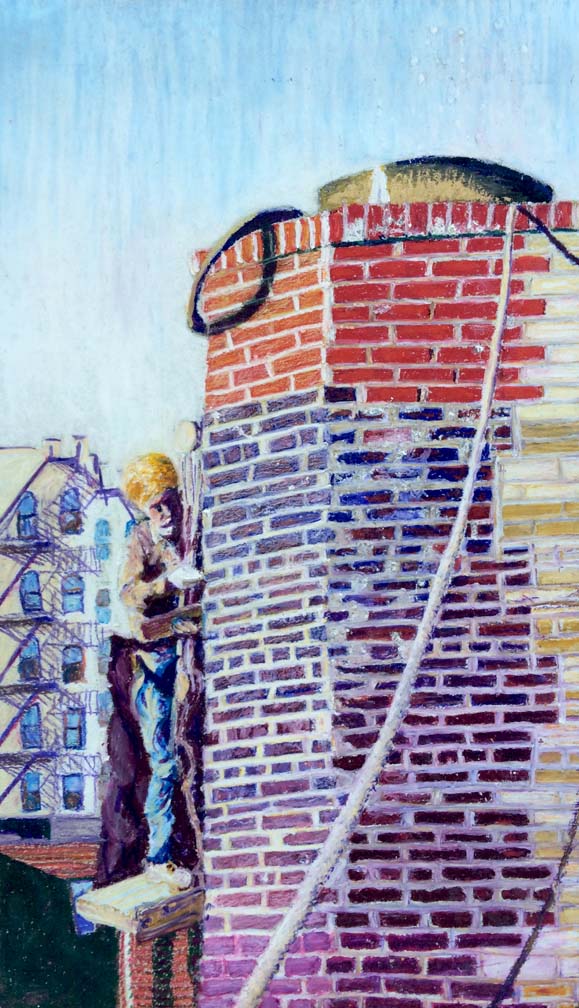
Chimney-Rebuild-2012

Brick Chimney Repair, Oil pastel on paper, 13-3/4 x 23-5/8″ © Tyska Sullivan

References:

1  John Daintith, A Dictionary Of Physics (Oxford Quick Reference), Oxford University Press, 6th edition, 2010.

2  Adelbert P. Mills, Materials Of Construction, John Wiley & Sons, Inc., New York, 1915.

3  Michael Merrigan P.E., The Masonry Society Journal, January-June, 1986.

Efflorescence: ef-flo-res-cence (ef’ le res’ens), 1. a change on the surface to a powdery substance upon exposure to air, as a crystalline substance through loss of water. 2. To become incrusted or covered with crystals of salt or the like through evaporation or chemical change.

4  Charles Lockwood, Brick And Brownstone, Abbeville Press Publishers, New York, 1972.

THE SANDBOX METAPHOR

In my beginning is my end …    … In my end is my beginning

T.S. Eliot, East Coker

The sandbox as a site and as an empty canvas. A place where a child is engaged in a game of free play as physical material is continually leveled, maneuvered and shaped into latent forms. A site and material liberated from any specific function as disparate objects are found and introduced within an indiscriminate playing field. Events transpire as figures and ground engage in developing or refining processes based on the desired motives or upon the response to chance encounters. If neglected, the site accepts its inevitable fate as the built forms smooth towards an approaching flatness. Entropy; the process of slow destruction seen in the ruins around us and when activity is forever exhausted all that will remain is a desert.

TS_Reflections-Greenpoint

Reflections of the Built Environment, Greenpoint, 2016. Oil pastel on paper, 22×30″ ©TyskaSullivan


The city with its hustle and bustle to meet new market demands, actively seeks change in the built environment. During prosperous times the city seeks to devour itself as old forms make way for new ones. A street smart city continually on the move, initiating new designs in response to emerging needs. As the market falls so does the activity and the need to develop. In the city, littered here and there are marginal places tucked away in forgotten corners or lost out on the fringes. Places removed from everyday life, deteriorating within a disregarded terrain containing discarded events. Out of sight means out of mind and this very neglect is also the opportunity for freedom.

Everyday complacent communities strive for permanence and reverence but likewise there can only be grounds for change with communities in squalor and impoverishment. Polarities exist in the need for development, whether it is the wiping clear of entire zones of destitution in order to work from a clean slate, to the piecemeal advancement in which existing character is respected and the steady seeds of growth are incorporated about the community. Within this active playground there is always the pervading tension between creation and response. Even the most marginal of places possess traces of humanity that are interconnected through time and across boundaries. The remote histories become transformations for future opportunities. Here within the developing environment, there is a dialogue between the senses and the imagination as the vivid material’s presence exchanges with the internal wanderings of the mind.

-TS

INTRO AND ORIGIN

Introduction

This website presents itself as an opportunity to further my experiences and investigations with architecture and the urban landscape, particularly in the New York City area. Along the way I hope to gain creative insights, communicate with others, and also strengthen the critical thought processes and future projects. The medium supports an ongoing sequence of presentations, covering projects from the past as well as any new inspirations that arise.

Being in and around the sites and activities about the environment is what interests me most. The work in the studio can only do so much to capture all the phenomenons present in the world. For me, figurative work whether it’s through paintings, drawings or photographs can be a highly limited form of representation. Visual images can have a “picture perfect” quality due to the perspective and framing but are only an illusion to the real. Time is made static and sensations are inhibited due to the prioritizing of the visual over other senses. To overcome some of these limitations the pictures I create are purposely imbued with haptic treatments, such as a hand and eye wrestling of material application, as well as distorted use of colors ranging from highly pure/bold tones to broken/muted tones. Oil pastels are my medium of choice to accomplish this and what I use most often.

The other medium which I admittedly undervalued in my past work a great deal is the written word. So much could be said of the qualities of writing and for this website I see my writings as a type of glue that can synthesize all my ideas, impressions, and creations together, while also establishing a dialogue between the site and studio and others.

Origin

For those of you who know me, you might be wondering why I’m using a strange name in place of my real first name. Well first of all, a common first name combined with a relatively common last name means I would be buried in the search engines. It’s nice to realize that by using my middle name in place of my first name I’m now maybe the only Tyska Sullivan in the world. Secondly, I’m somewhat accustomed to acquiring different nicknames at different stages of my life so here’s to another.

Tyska, for those interested in the history of the name, is my middle name, my mothers maiden name, my grandparents surname, and so on. The origin is in Poland and is traced to the city of Lomza and surrounding cities and regions, northeast of the capital Warsaw. Spelled originally as Tyszka, and from what I can gather, this surname is ironically a nickname or short from of the name of Greek origin Timotheos, spelled Tymoteusz in its polish form, anglicized as Timothy and therefore Timmy.