




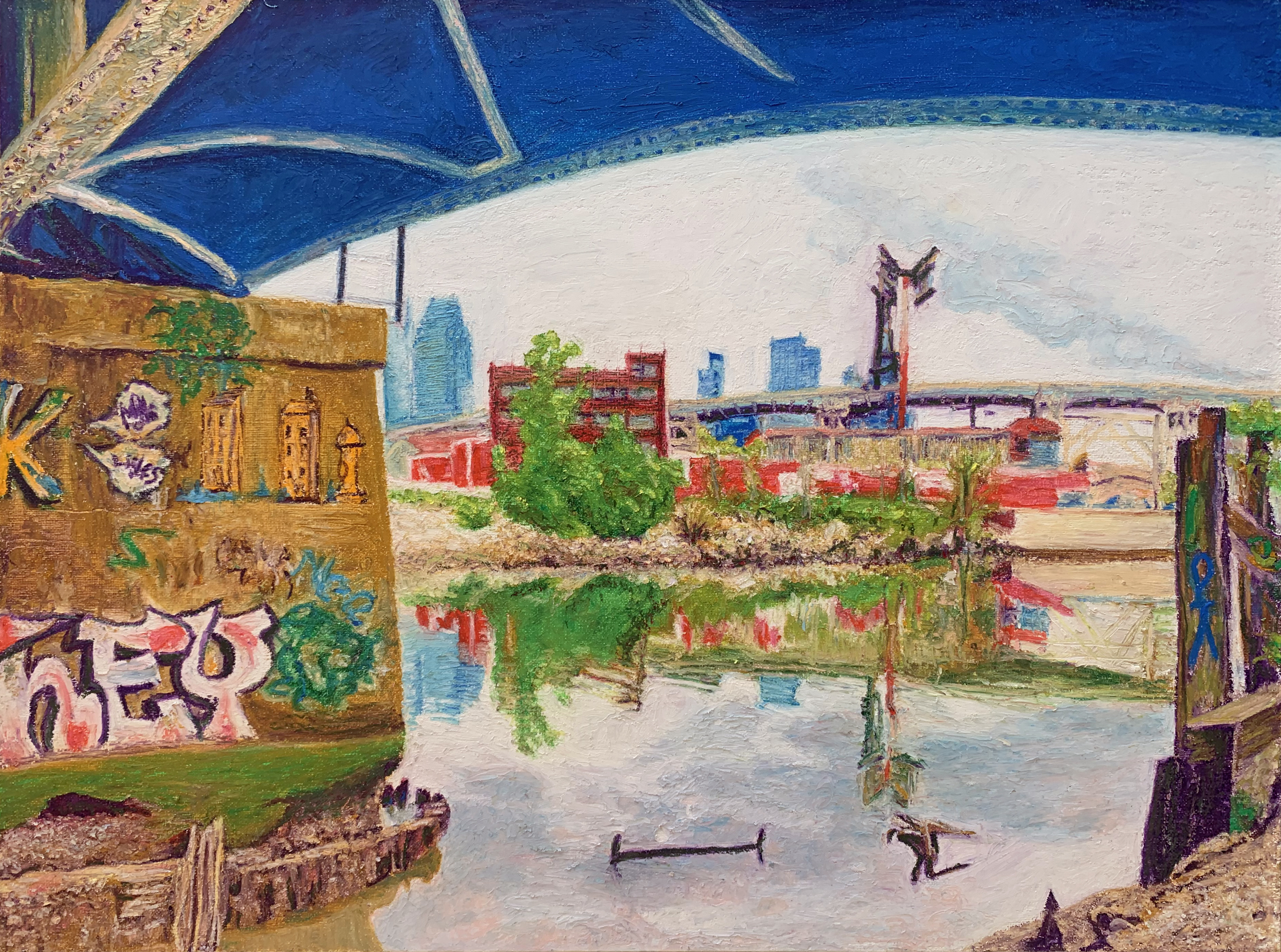

Band: BREAKING HANDS
Album: CROSS HERE
Yea, they were all dead and they don’t even know it yet
We set sail full steam ahead
You want a credible source well I was there
They were under my command
To heed the warning sign and to refuse my call
To fail to carry this out is just like how a coward acts
Back at the dock I held my fate in my hands
Set out twenty two cards “Here, take one”
With a raised hand the high priest blessed me yet he stood there upside down
The high seas loosened her belt and went round, round like a carousel
It turns out that the red in the sky that morning had an appetite
And a face of an enemy that made a silent call for me to turn this ship around
All hands on deck, but there was that sound
oh how the water cried
Sink or swim, man down, polo
game we played like we’ve never been touched
by the sea
Yea they were all dead and they don’t even know it yet
you let the bomb there just tick away
Heavy weight let it go feel the remorse leaving in my wake
To choose between a sick heart or to wear this mark of cain
To face my destiny I keep feeling its call and it’s calling out to us all
All hands on deck, but there’s no going back
we look more stunned than mad
All I have is a ship that streams
and it goes on with no wake
and with no wind
but we’re still at hand
Watch it all get blown away like frail reeds by the very same wind that you created
And what carries no weight at all, counts for nothing in this godforsaken state
And that driving hand grabbing at all those desires, but there it is, that other side of the coin
all insatiable destruction and shattering and swallowing
of our lives
I would never turn my back on you
Let’s keep our contradictions to ourselves
And I won’t resent you
for your tide of love and all the harm it brings
Earth mother we will feed this perpetual fire and feast on our beer and bread
And we clear out all those old oak homes so we can build better looking buildings here instead
Earth mother of a thousand names and so many other names that we continue to bestow
Can I borrow that scarab you use to hold your gown together yea the one you refuse
to ever let go
I know you so well but there’s that mystery
I can hardly claim to penetrate that
I’m digging myself in
but I would never dare to lift the veil you wear
It seems like part of you has to come apart
in order to shed another hanging tear
Receive another teardrop
Into this great amber bath of a sea
(play it for me guitarist)
Take a walk where there was once some lush green woods
Making my way up on top of such a barren hill
Looking down upon the still water
And feel the dripping sky above.
Earth mother receive another drop of this hanging tear
into this amber bath it will grow each year
And I know that you’re gonna tear us apart with your
tide of love and all the harm it brings
So I’ll lay to waste and return next spring
Then we get to start all over again
Sinking moon into the street’s inky black
Out jumps a buffoon
Kisses me and I hear you shout
Fill him up, to the brim
So worn out, with lips so thin
Wear his guise, a big fat grin
They will drag their feet and roll their eyes
Heading home to the sound of wolves cries
To find the flames licking up the walls, as it burns away
To drown yourself after taking a death by flame
Only some ashes and a torch that’s left
Take my hand
Let’s walk away
We help ourselves to the brimming banquet hall
We lose ourselves
Hear the tearing of your dress
Wear it out, reveal some more
It sheds about, head for the door
When the plates I juggle hit the floor
They all form a ring and roll their eyes
Cast out to the sound of wolves cries
To pull the rug out from under the foot of where they stand
To die by a fall smothered by their own weight
Holding us back or being led astray
I’ll take your hand
You said cross here
Fill him up
At the brimming banquet hall we’ll send you off
Wear it out
And the shedding of the skin will only reveal some more
That you’ll wear out.
Loud broken footsteps it’s the way that I walk
You stand up, you stand up for your king, if you don’t you will fall
But now I see him plead on bended knee, without his crown,
He kinda looks like me
They hand out his clothes they give me his shoes
I will wear them out. We all sing and shout
Now the beach is lined with savages with the head of the king
The wind has cleared his sinuses
So now he can sing
(wind exhales)
Just across the border at a stateside diner
Someone taps my shoulder and I see a hardcore carnivore
There was meaning in her bite, it was scrawled on the wall
when I relieved myself, it was written on the back of a stall
I tried get up but the crowd was just standing around
for something they don’t really stand for. I just want to get out
They all hold modern menus so common to us all.
It doesn’t mean a thing to me, means nothing that’s all
On my way home on my hands and knees.
I tread the tiger’s tail I step carefully
Opportunity. One day I was scaling the heights and the next
I was hanging on air. Overdose is a threat. So I signal a flare.
I wander in a basement and see a chair inside a circle of three
I sit before they talk and let them interrogate me
I talk about some kinda wonderland
And the look in their eyes reflects me like the back of my hand
Like a flat screen monitor, mimicking the face of a clock
when it withdraws from sight, I’ll know how much time I’ve got
I might wake before the alarm clocks call
So I rule that we shake hands and crawl past..
Burned out bridges with explosive air
Deafening weekend crowds, we learn to step with care
worn down to the socks, so I left them there
I’ll need new shoes, I will find a pair
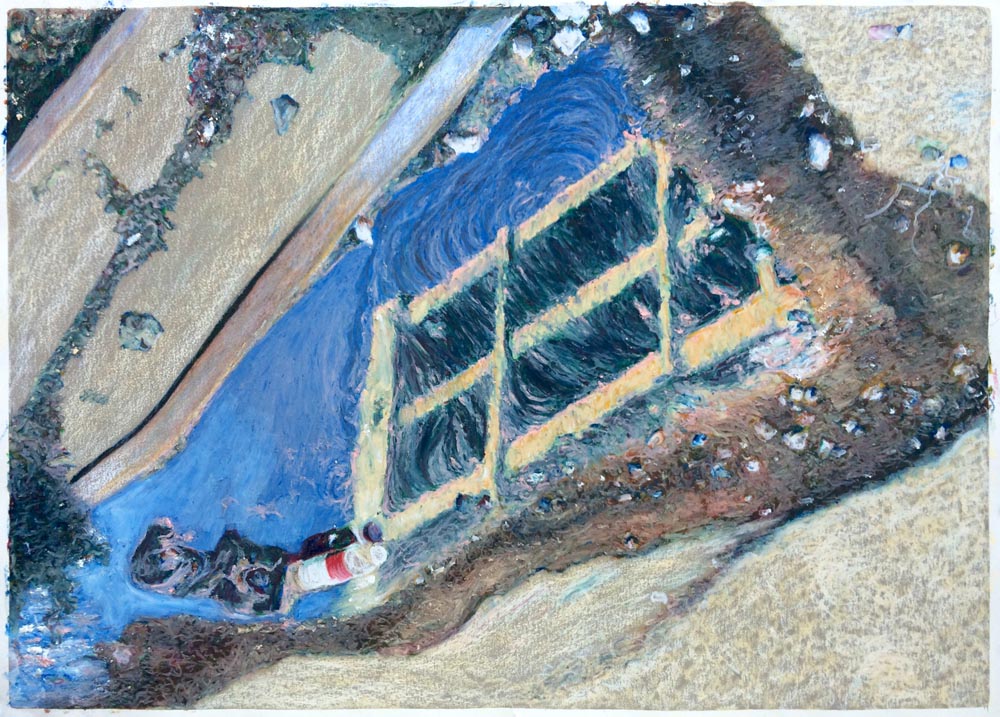
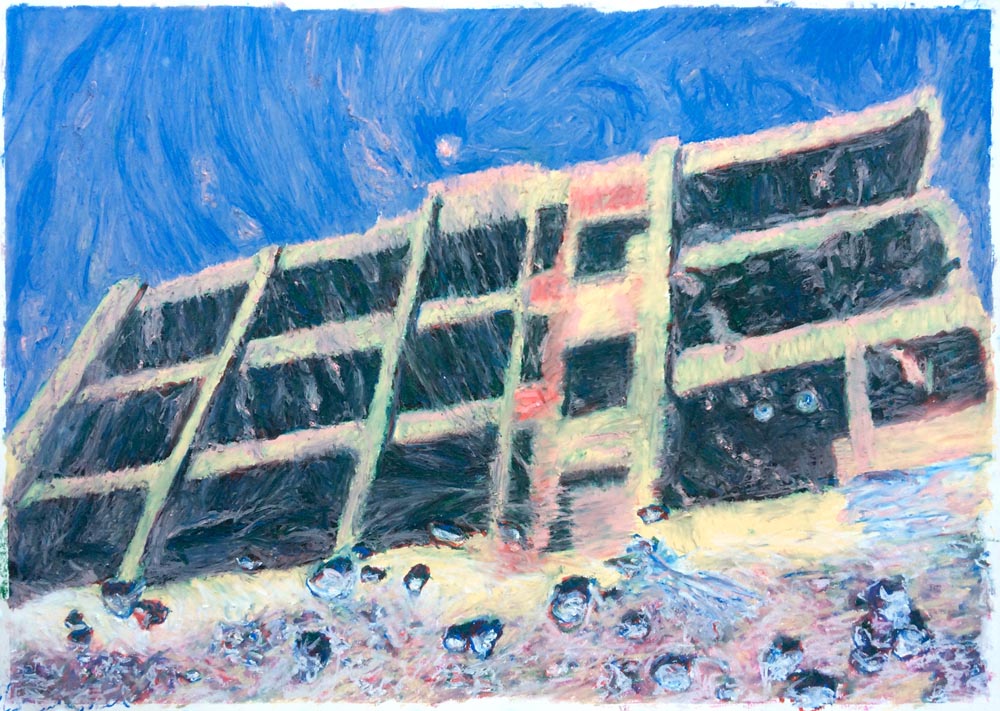
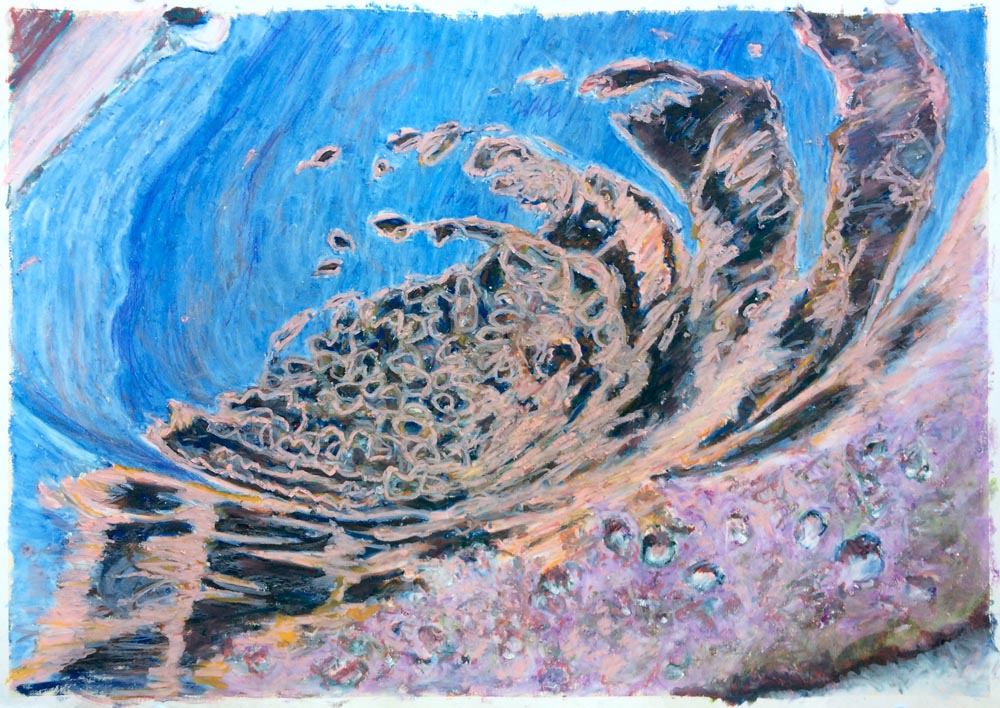 each panel 27-1/2″ x 19-1/2. Oil Pastel on Paper.
National Mall, Washington D.C. 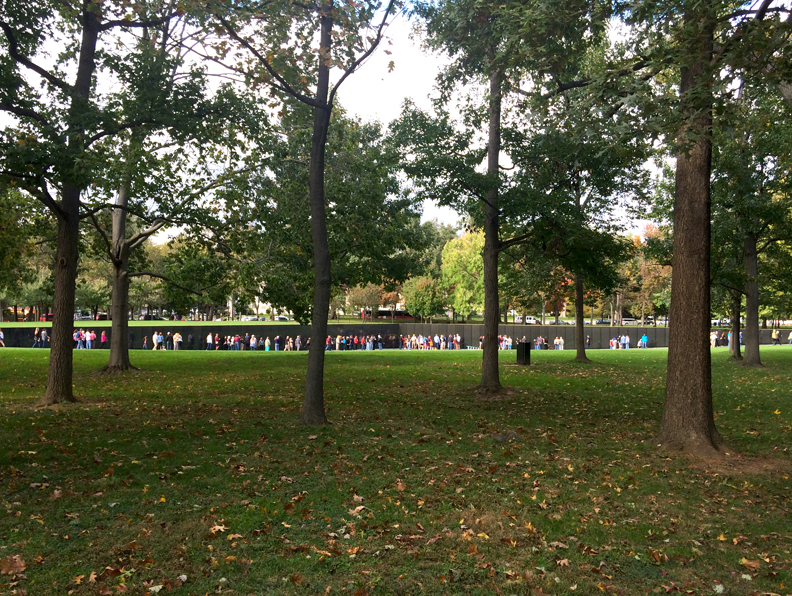
“nihilistic slab of stone” (1)
“black gash of shame” . . . “a degrading ditch” (2)
“a black trench that scars the Mall. Black walls, the universal color of shame and sorrow and degradation. Hidden in a hole in the ground, with no means of access for those Vietnam veterans who are condemned to spend the rest of their days in a wheelchair. Perhaps that’s an appropriate design for those who would spit on us still. But can America truly mean that we should feel honored by that black pit?” (3)
The quotes above are just a few of the many criticisms lobbied against the winning design by Maya Lin and today seem overly harsh for such an admired memorial dedicated to the lives lost during the Vietnam War. At the time during the early 80’s, given that the war was a recent event, the general public and the media was outspoken in their attacks against the memorial and the perceived statement they felt it was trying to make. Much of this reactive critique was subjective judgements made in passing, coming from their own interpretations of the war as if the memorial was placing itself on some oppositional ground in relation to their own. To many this design was a betrayal to the very idea of what a memorial should be. The uncommon use of polished black granite instead of using white limestone or marble (4) and the horizontal nature of the design which situated itself in contrast to the great vertical monuments of the past was a distinct break from convention. For a memorial that seemed to lack political statement it certainly triggered a heated debate. Looking back much of it was due to the polarity in people’s feelings about the war and also in the confusion of the project’s aims. The people and critics expected to see a monument as a tribute to an important event and failed to see a memorial as a remembrance for those who died.
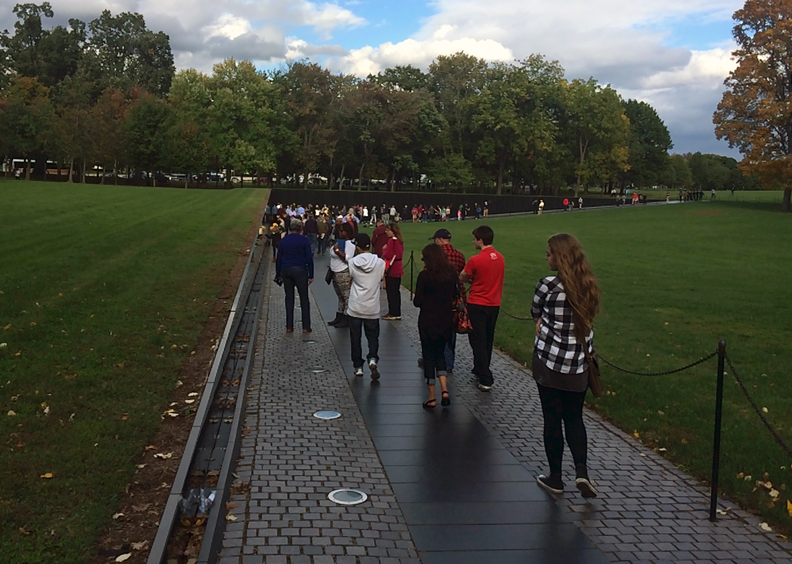
When the project founder, Vietnam War veteran Jan Scuggs, proposed the memorial for the competition he felt that the submitted designs should avoid making statements about the correctness of the war. “Rather, by honoring those who sacrificed, we hope to provide a symbol of national unity and reconciliation.” (5) When researching designs, Lin felt she had the opportunity to design a memorial that would honor those lives lost and to steer away from past memorials which aim at more general statements about the war’s achievements. (6) Lin’s winning design is very much in line with Scuggs statements in the program, “the memorial should be conciliatory, transcending the tragedy of the war.” (7) After reviewing 1,421 submissions for the memorial, the competition committee selected Lin’s design but this decision was soon met with a backlash even coming from initial supporters of the fund. Maybe Scuggs underestimated the public reaction and was too idealistic in thinking that people would set aside their opinions for a memorial that he hoped would transcend any statement. The war was certainly controversial and you can’t blame people for the strong reactions which would bring the project to a temporary halt. The critics felt the memorial was a severe break from tradition and eventually a compromise was made with the addition of the Three Soldiers Statue nearby the memorial. The need for some semblance to convention is a typical response and when faced with changing circumstances the immediate reaction for most people is that they rather it not happen during their time and not in their place.
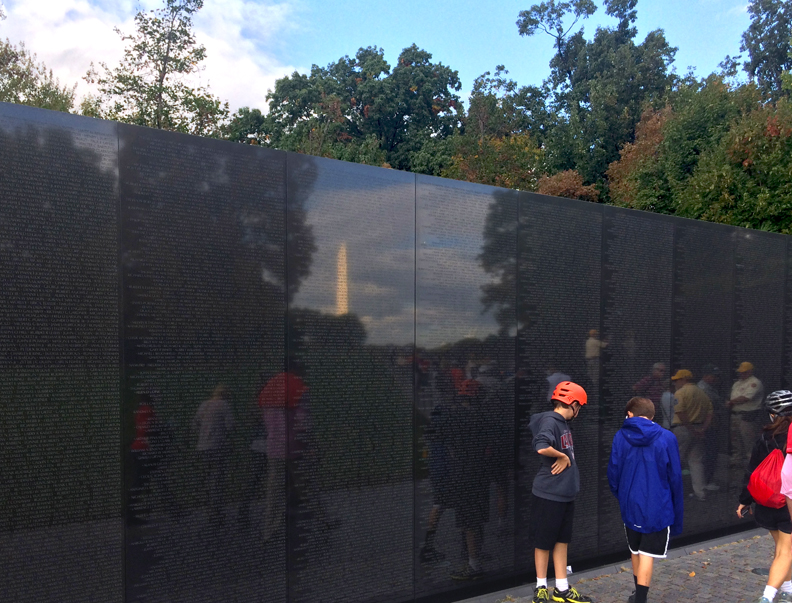
My first proper introduction to the memorial was during my first year of architecture school which was over fifteen years past the memorial’s date of completion. Here I encountered universal praise for the design in stark contrast to the aforementioned negative statements. Lin’s project was covered in class lectures and I further read about it in library books; the memorial was unanimously toted as an important work of landscape architecture and a groundbreaking achievement as a contemporary monument. The design became an inspiration on a number of my own projects, most notably in a project proposal that involved placing a factory within a historic aqueduct park setting. The influence of the design was evident in how the obtrusive nature of the factory was set within the historic landscape by suppressing the more severe parts of the factory into the slope of the ground. The emerging features such as the overhead assembly lines for the factory were placed in a respectful manner in relation to the towering ruins of the Roman aqueducts. Here I was using the relationship of site and form as seen in Lin’s memorial as a conceptual tool. If asked, I felt I understood the memorial very well, yet in fact much of my understanding was only from a design standpoint and for a project I admired immensely I had yet to visit the site in person. Though I was never critical of the memorial, my knowledge of it came from just as a detached perspective than the earlier critics. We were only seeing it through our own desires and aims.
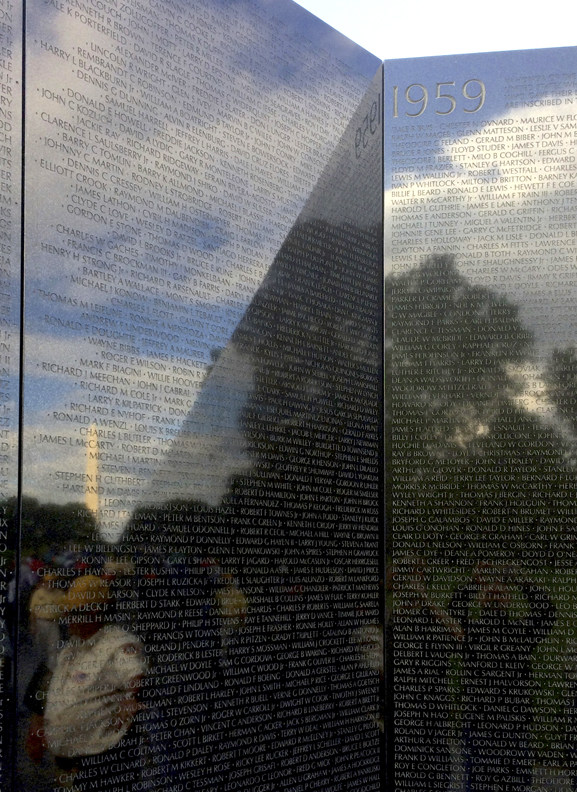
In 2014, when I visit the site in person, the striking reality is that I’m experiencing the memorial for the first time and no longer as a detached concept of drawings, pictures and text serving as a design influence. As I move into the site I am struck by the reflective quality of the dark granite which doubles myself and the bodies of others. Myself and its other situated outside and within the softened surface of the wall as I experience a very intimate scale and relationship with the site and most importantly with the names which imprint the walls reflective interface. Over 58,000 names are listed row upon row in chronological sequence along the length of the wall and all around eye level. Over to my side I see someone “rubbing” a name. This is the process of transferring the name with a pencil or crayon onto a piece of paper creating a physical form for one to carry home as a reminder of a loved one. I see someone reach out to touch a name and their double reciprocates the action from the other side as they come into direct contact with a name. I think of the captious quote which compared the use of the names as a mode of listing, “Not as a death of a cause but as they might as well have been traffic accidents.” (8) This is nothing of that sort with a very tangible and personable experience. Though the names lack a grandness in scale or height as seen by the inscription of the Gettysburg Address in the nearby Lincoln Memorial, the names take on a more intimate feel. I start to read names on the wall and even sound out some as I give voice to those who never got their say. One power the memorial has is that I can’t help to not tear up when I come face to face with all these names and I struggle to control the swell of emotion. It’s hard to comprehend the immensity of it all, not knowing the individual circumstances each person faced but here they are brought together in one solemn place. At the end of the day you can’t fault a person’s sentiments when a subject is so near and dear. You can only hope that with time the underlying meaning of things will emerge and withhold over time.
“Brought to a sharp awareness of such a loss, it is up to each individual to resolve or come to terms with this loss. For death is in the end a personal and private matter, and the area contained within this memorial is a quiet place meant for personal reflection and private reckoning. ” Maya Lin (9)

(1) Wills, Denise. “The Vietnam Memorial’s History.” Washingtonian.
(2) Marita Sturken, “The Aesthetics of Absence: Rebuilding Ground Zero,” American Ethnologist 31, no. 3 (August 2004): 122.
(3) Veteran Tom Carhart quoted in Elizabeth Hess, “Vietnam: Memorials of Misfortune”, in Unwinding the Vietnam War: From War into Peace ed. Reese Williams (Seattle 1987) 265.
(4) The Vietnam Veterans Memorial is a stark contrast with the whiteness and verticality of the Lincoln Memorial, Washington Monument and the World War II Memorial all nearby in the National Mall.
(5) Karal Ann Marling and Robert Silberman, “The Statue Near the Wall: The Vietnam Veterans Memorial and the Art of Remembering,” Smithsonian Studies in American Art 1, no. 1 (Spring 1987): 10.
(6) Maya Lin, Boundaries, Simon & Schuster Paperbacks, New York, 2000, pg. 4:09.
(7) Vietnam Veterans Memorial Competition Design Program, Washington D.C., 1980, 16.
(8) “Stop that Monument”, National Review, 18 Sep. 1981, 1064.
(9) Lin, pg. 4:05.
All photographs Tyska Sullivan ©2014

To protect a building or home from the outside elements it is vital that the material components of the exterior skin are durable and well-maintained. Every object is subject to the 2nd law of thermodynamics (1), the universal law of decay, and without any maintenance protocol, the effects of this perpetual disorder are costly. The deterioration is not consistent and exposure is an important determinant in the higher rates of failure at more susceptible areas. Precipitation is a fact of life and the external dynamics of wind, rain, and the lack of sunlight to dry out surfaces contribute in the freeze/thaw process; a dangerous cycle of exponential material decline.
In the construction industry, brick and mortar is the “tried and true” building material owing to its uniformity, reliability, ease of production and craft. (2) “High-technology” construction materials require specialized labor, while the brick with its corresponding scale related to the worker’s hand has been used throughout history, across many climates and cultures. Brick and mortar construction is a flexible system with the ability to add units, remove sections, cut into walls, and infill openings at any time. It also has the particular ability to be both structure and skin. As a structural support it can extend from foundation to the roof as it bears the horizontal members at each floor. As a skin it functions as a permeable barrier to protect against the external elements and to allow the wall to breathe, therefore allowing excessive moisture out. It is important to note that the exterior wall stands between the differing interior/exterior temperatures and humidities, which seek equilibrium.
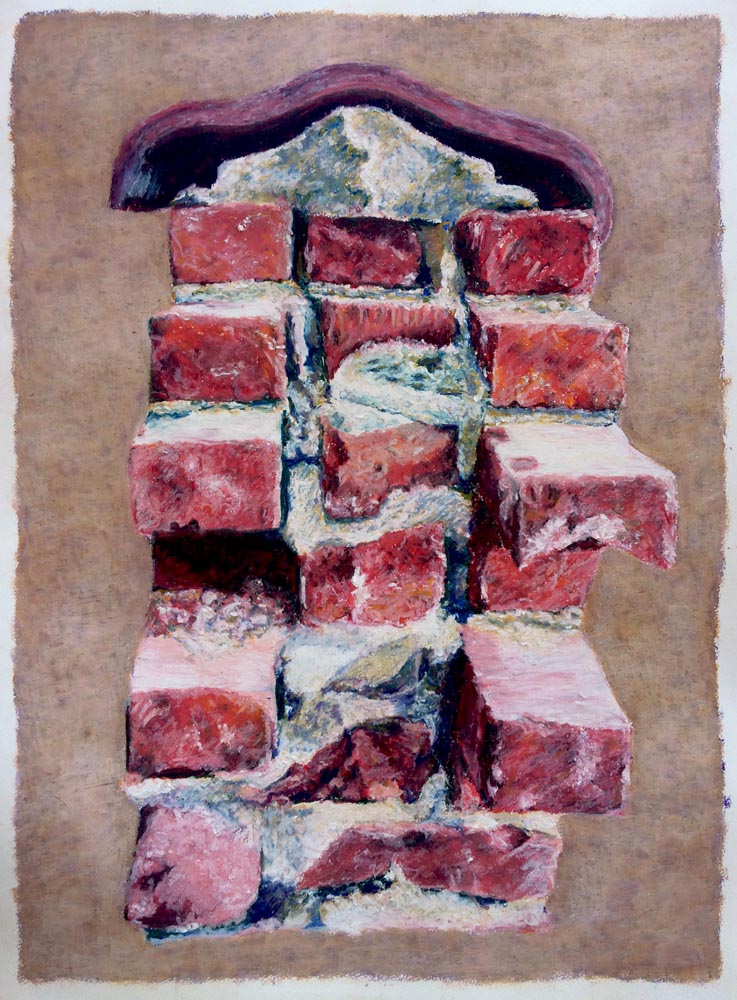
Brick Parapet Section, Oil pastel on paper, 21-3/4 x 29-3/4″ © Tyska Sullivan
A breach at the building’s membrane will occur due to several factors such as the aging of materials, environmental conditions or just poor design/construction details. One of the merits of brick masonry is its ability to reveal the signs and symptoms which relate to a corresponding pathology. Efflorescence (3) at the wall’s exterior suggests excessive moisture built-up at the wall’s interior and its persistent migration to the surface. Water is likely infiltrating at a source nearby or above the problem condition. (The source of water could be from below if the efflorescence is near the foundation) This revealing process is beneficial in diagnosis and treatment, whereas with some modern material and cladding, the signs and symptoms are not as readily apparent and the exterior will maintain its typical look while concealing the underlying issues.
In a lot of cases the sign of the pathological condition exists but is not corrected in time. Deferred treatment for a condition can only lead to accelerated deterioration later on. For example in Parapet Rebuild (title image), there were open joints at the coping stones which cap the top of the parapet. This breach in the building’s exterior membrane led to water build-up at the interior cavities of the wall. Moisture is at its worst when it’s in a position to freeze, leading to the expansion of water at the time of freezing. The expansion will put pressure at the surrounding masonry, (4) in this case showing up as a vertical cracks at the exterior of the wall and extending the height of the parapet. The new cracks allow an added source of water infiltration, which means more expansion and pressure upon the materials, continuing a very dangerous cycle. At this point it’s too late to seal the original source of water infiltration at the open joint of the coping stone because the wall cracks need to be addressed. So in this case the whole section of parapet at the damaged areas was rebuilt.

Brick Chimney Repair, Oil pastel on paper, 13-3/4 x 23-5/8″ © Tyska Sullivan
References:
1 John Daintith, A Dictionary Of Physics (Oxford Quick Reference), Oxford University Press, 6th edition, 2010.
2 Adelbert P. Mills, Materials Of Construction, John Wiley & Sons, Inc., New York, 1915.
3 Michael Merrigan P.E., The Masonry Society Journal, January-June, 1986.
Efflorescence: ef-flo-res-cence (ef’ le res’ens), 1. a change on the surface to a powdery substance upon exposure to air, as a crystalline substance through loss of water. 2. To become incrusted or covered with crystals of salt or the like through evaporation or chemical change.
4 Charles Lockwood, Brick And Brownstone, Abbeville Press Publishers, New York, 1972.
“In my beginning is my end … … In my end is my beginning”
T.S. Eliot, East Coker
The sandbox as a site and as an empty canvas. A place where a child is engaged in a game of free play as physical material is continually leveled, maneuvered and shaped into latent forms. A site and material liberated from any specific function as disparate objects are found and introduced within an indiscriminate playing field. Events transpire as figures and ground engage in developing or refining processes based on the desired motives or upon the response to chance encounters. If neglected, the site accepts its inevitable fate as the built forms smooth towards an approaching flatness. Entropy; the process of slow destruction seen in the ruins around us and when activity is forever exhausted all that will remain is a desert.

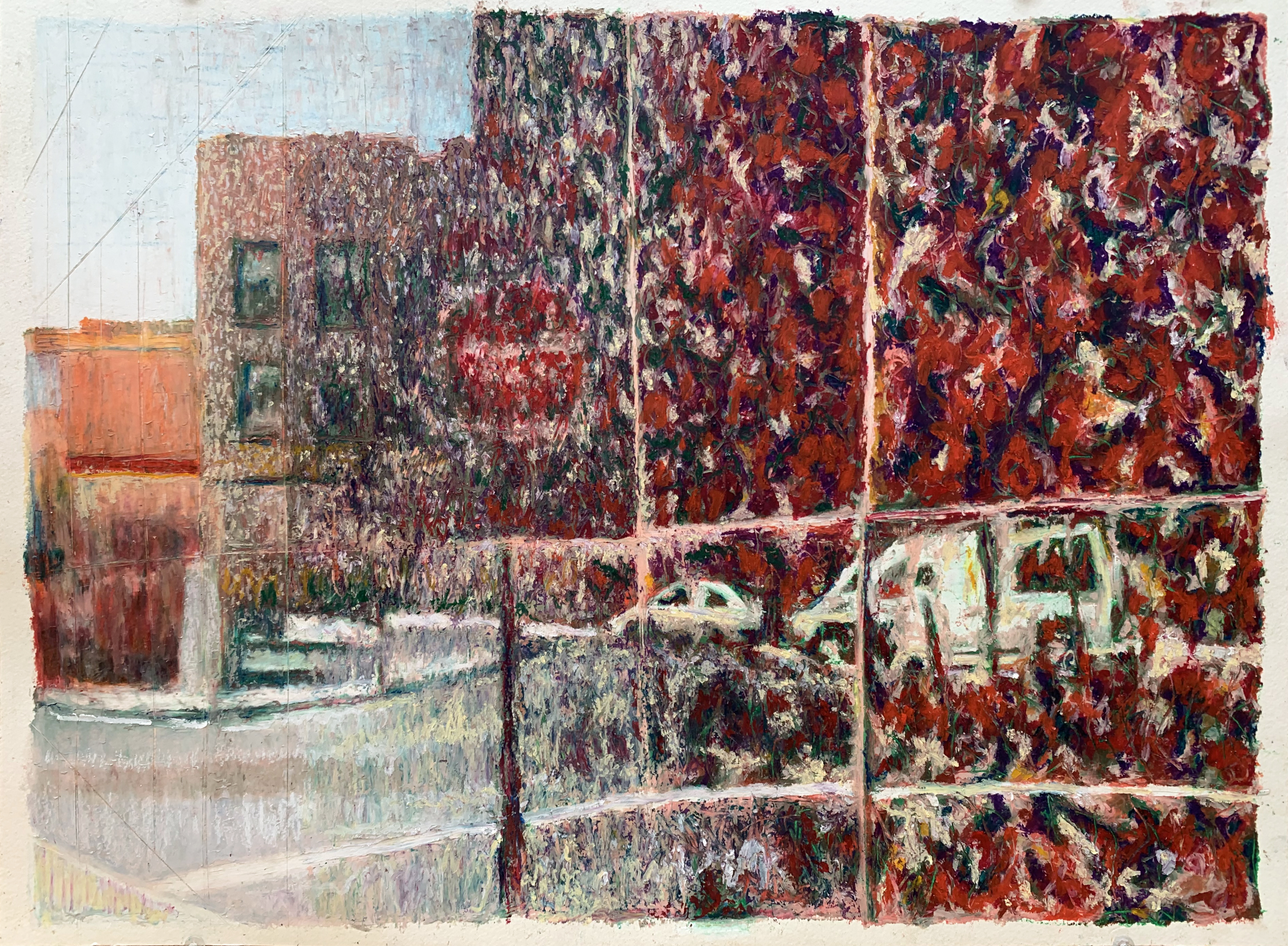
Reflections of the Built Environment, Greenpoint, 2016. Oil pastel on paper, 22×30″ ©TyskaSullivan
The city with its hustle and bustle to meet new market demands, actively seeks change in the built environment. During prosperous times the city seeks to devour itself as old forms make way for new ones. A street smart city continually on the move, initiating new designs in response to emerging needs. As the market falls so does the activity and the need to develop. In the city, littered here and there are marginal places tucked away in forgotten corners or lost out on the fringes. Places removed from everyday life, deteriorating within a disregarded terrain containing discarded events. Out of sight means out of mind and this very neglect is also the opportunity for freedom.
Everyday complacent communities strive for permanence and reverence but likewise there can only be grounds for change with communities in squalor and impoverishment. Polarities exist in the need for development, whether it is the wiping clear of entire zones of destitution in order to work from a clean slate, to the piecemeal advancement in which existing character is respected and the steady seeds of growth are incorporated about the community. Within this active playground there is always the pervading tension between creation and response. Even the most marginal of places possess traces of humanity that are interconnected through time and across boundaries. The remote histories become transformations for future opportunities. Here within the developing environment, there is a dialogue between the senses and the imagination as the vivid material’s presence exchanges with the internal wanderings of the mind.
-TS
Introduction
This website presents itself as an opportunity to further my experiences and investigations with architecture and the urban landscape, particularly in the New York City area. Along the way I hope to gain creative insights, communicate with others, and also strengthen the critical thought processes and future projects. The medium supports an ongoing sequence of presentations, covering projects from the past as well as any new inspirations that arise.
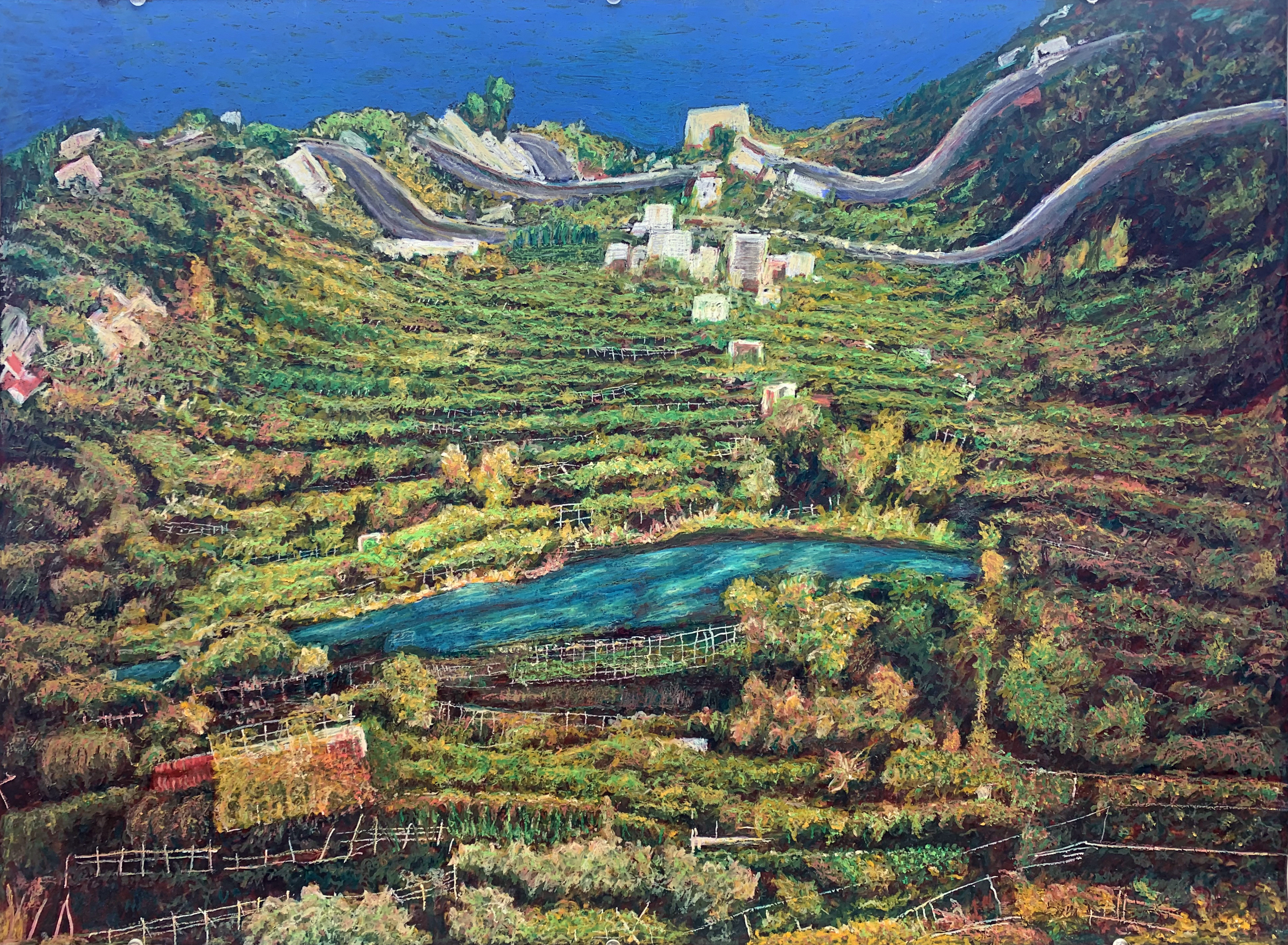
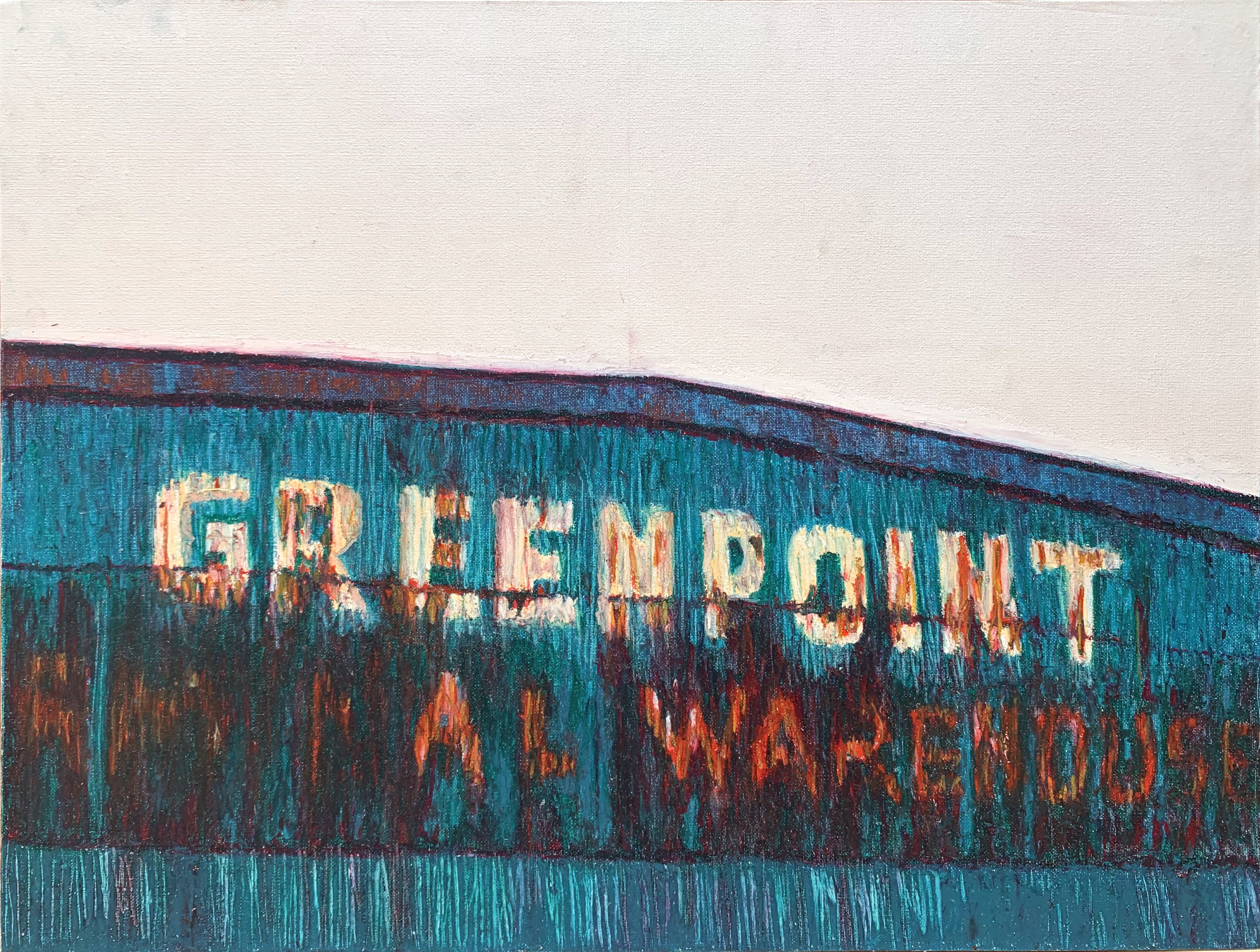
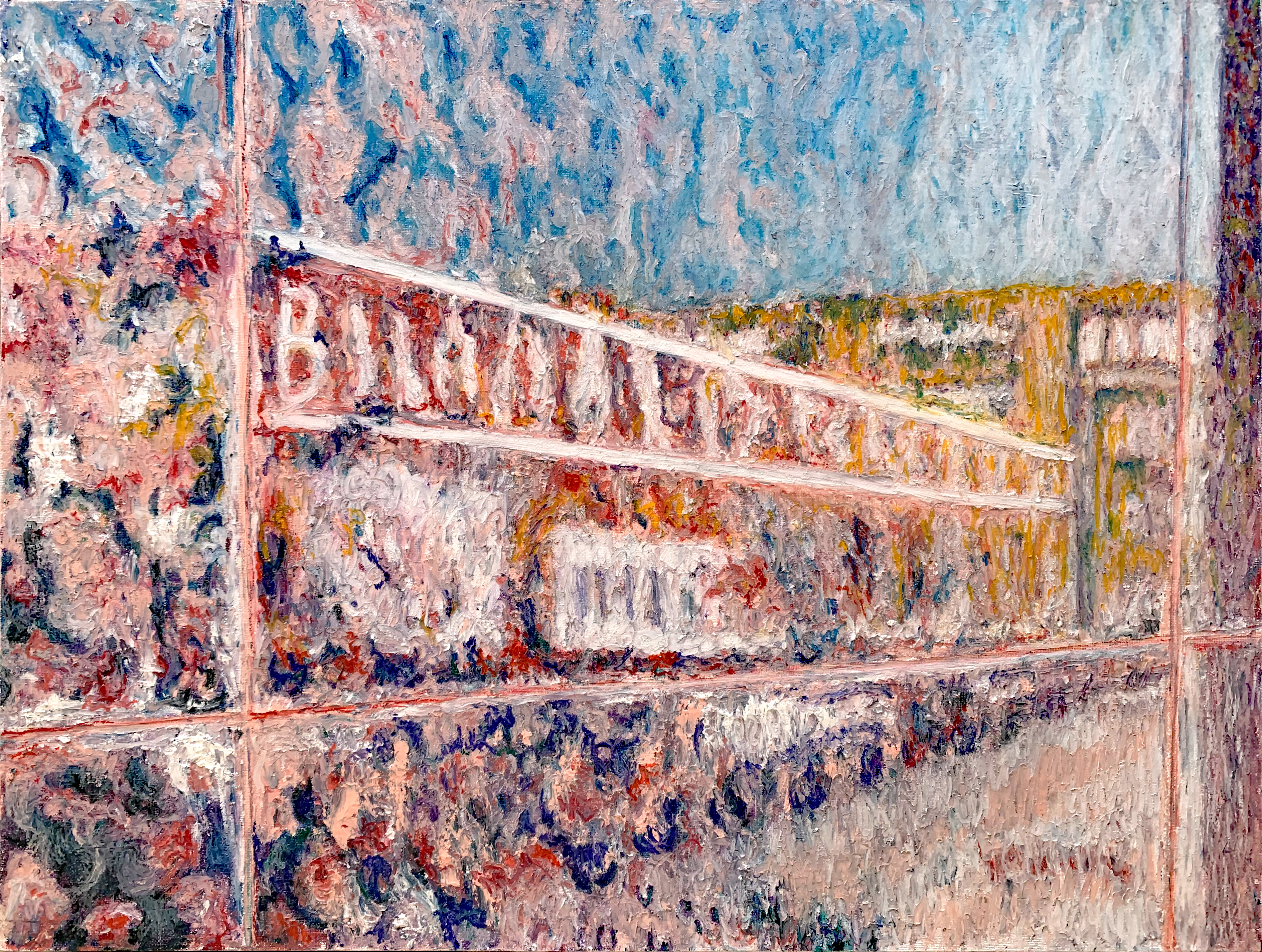
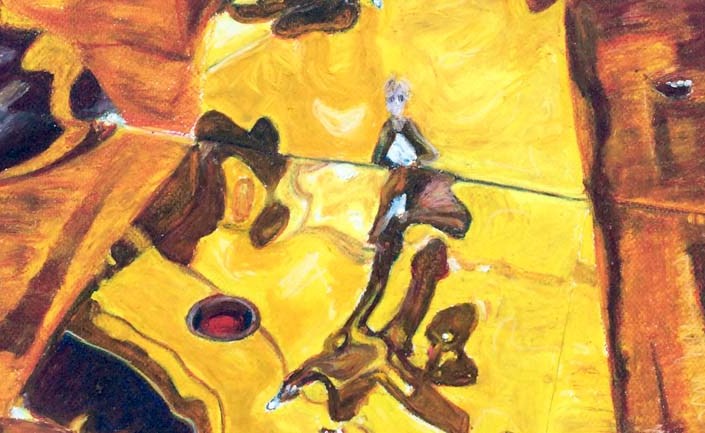
Being in and around the sites and activities about the environment is what interests me most. The work in the studio can only do so much to capture all the phenomenons present in the world. For me, figurative work whether it’s through paintings, drawings or photographs can be a highly limited form of representation. Visual images can have a “picture perfect” quality due to the perspective and framing but are only an illusion to the real. Time is made static and sensations are inhibited due to the prioritizing of the visual over other senses. To overcome some of these limitations the pictures I create are purposely imbued with haptic treatments, such as a hand and eye wrestling of material application, as well as distorted use of colors ranging from highly pure/bold tones to broken/muted tones. Oil pastels are my medium of choice to accomplish this and what I use most often.
The other medium which I admittedly undervalued in my past work a great deal is the written word. So much could be said of the qualities of writing and for this website I see my writings as a type of glue that can synthesize all my ideas, impressions, and creations together, while also establishing a dialogue between the site and studio and others.
Origin
For those of you who know me, you might be wondering why I’m using a strange name in place of my real first name. Well first of all, a common first name combined with a relatively common last name means I would be buried in the search engines. It’s nice to realize that by using my middle name in place of my first name I’m now maybe the only Tyska Sullivan in the world. Secondly, I’m somewhat accustomed to acquiring different nicknames at different stages of my life so here’s to another.
Tyska, for those interested in the history of the name, is my middle name, my mothers maiden name, my grandparents surname, and so on. The origin is in Poland and is traced to the city of Lomza and surrounding cities and regions, northeast of the capital Warsaw. Spelled originally as Tyszka, and from what I can gather, this surname is ironically a nickname or short from of the name of Greek origin Timotheos, spelled Tymoteusz in its polish form, anglicized as Timothy and therefore Timmy.
 Tyska Sullivan