
To protect a building or home from the outside elements it is vital that the material components of the exterior skin are durable and well-maintained. Every object is subject to the 2nd law of thermodynamics (1), the universal law of decay, and without any maintenance protocol, the effects of this perpetual disorder are costly. The deterioration is not consistent and exposure is an important determinant in the higher rates of failure at more susceptible areas. Precipitation is a fact of life and the external dynamics of wind, rain, and the lack of sunlight to dry out surfaces contribute in the freeze/thaw process; a dangerous cycle of exponential material decline.
In the construction industry, brick and mortar is the “tried and true” building material owing to its uniformity, reliability, ease of production and craft. (2) “High-technology” construction materials require specialized labor, while the brick with its corresponding scale related to the worker’s hand has been used throughout history, across many climates and cultures. Brick and mortar construction is a flexible system with the ability to add units, remove sections, cut into walls, and infill openings at any time. It also has the particular ability to be both structure and skin. As a structural support it can extend from foundation to the roof as it bears the horizontal members at each floor. As a skin it functions as a permeable barrier to protect against the external elements and to allow the wall to breathe, therefore allowing excessive moisture out. It is important to note that the exterior wall stands between the differing interior/exterior temperatures and humidities, which seek equilibrium.

Brick Parapet Section, Oil pastel on paper, 21-3/4 x 29-3/4″ © Tyska Sullivan
A breach at the building’s membrane will occur due to several factors such as the aging of materials, environmental conditions or just poor design/construction details. One of the merits of brick masonry is its ability to reveal the signs and symptoms which relate to a corresponding pathology. Efflorescence (3) at the wall’s exterior suggests excessive moisture built-up at the wall’s interior and its persistent migration to the surface. Water is likely infiltrating at a source nearby or above the problem condition. (The source of water could be from below if the efflorescence is near the foundation) This revealing process is beneficial in diagnosis and treatment, whereas with some modern material and cladding, the signs and symptoms are not as readily apparent and the exterior will maintain its typical look while concealing the underlying issues.
In a lot of cases the sign of the pathological condition exists but is not corrected in time. Deferred treatment for a condition can only lead to accelerated deterioration later on. For example in Parapet Rebuild (title image), there were open joints at the coping stones which cap the top of the parapet. This breach in the building’s exterior membrane led to water build-up at the interior cavities of the wall. Moisture is at its worst when it’s in a position to freeze, leading to the expansion of water at the time of freezing. The expansion will put pressure at the surrounding masonry, (4) in this case showing up as a vertical cracks at the exterior of the wall and extending the height of the parapet. The new cracks allow an added source of water infiltration, which means more expansion and pressure upon the materials, continuing a very dangerous cycle. At this point it’s too late to seal the original source of water infiltration at the open joint of the coping stone because the wall cracks need to be addressed. So in this case the whole section of parapet at the damaged areas was rebuilt.
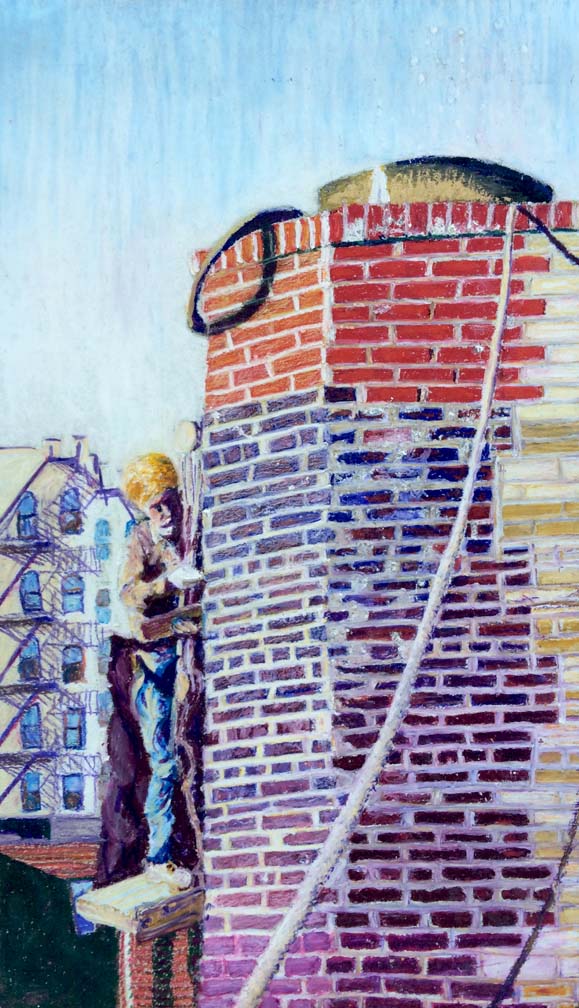
Brick Chimney Repair, Oil pastel on paper, 13-3/4 x 23-5/8″ © Tyska Sullivan
References:
1 John Daintith, A Dictionary Of Physics (Oxford Quick Reference), Oxford University Press, 6th edition, 2010.
2 Adelbert P. Mills, Materials Of Construction, John Wiley & Sons, Inc., New York, 1915.
3 Michael Merrigan P.E., The Masonry Society Journal, January-June, 1986.
Efflorescence: ef-flo-res-cence (ef’ le res’ens), 1. a change on the surface to a powdery substance upon exposure to air, as a crystalline substance through loss of water. 2. To become incrusted or covered with crystals of salt or the like through evaporation or chemical change.
4 Charles Lockwood, Brick And Brownstone, Abbeville Press Publishers, New York, 1972.


 Tyska Sullivan